
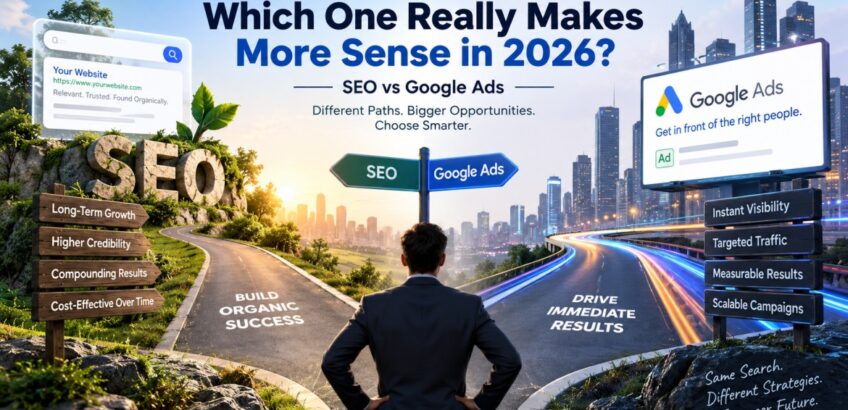
SEO vs Google Ads in 2026: Which Strategy Actually Makes More Sense?
The SEO vs Google Ads debate is often reduced to a familiar argument: SEO is a long-term strategy, while Google Ads delivers immediate traffic.
That explanation is no longer sufficient.
In 2026, search marketing has become considerably more complex. Search results are increasingly influenced by AI-generated experiences, commercial SERP features, local results, shopping surfaces, video, brand signals, and changing user behavior. At the same time, paid search has become more automated, with machine learning playing a greater role in bidding, targeting, creative optimization, and campaign management.
As a result, the real question is not simply:
“Should a business invest in SEO or Google Ads?”
The more sophisticated question is:
“Which combination of organic and paid search produces the strongest incremental business value at an acceptable acquisition cost?”
That distinction changes the entire conversation.
SEO and Google Ads Are Not Equivalent Traffic Channels
SEO and Google Ads may occupy the same search results page, but they operate under fundamentally different economic models.
SEO is primarily an asset-building activity. A company invests in technical infrastructure, content, authority, internal linking, digital PR, topical coverage, and user experience. The objective is to create search visibility that can continue producing value without paying an advertising fee for every visit.
Google Ads is primarily a demand-capture and demand-allocation mechanism. A company pays to access search demand and uses targeting, bidding, creative, landing pages, and conversion signals to determine how much it is willing to pay for that opportunity.
This creates an important distinction:
SEO tends to build search equity; Google Ads tends to buy access to existing search demand.
Neither model is inherently superior.
The economics depend on what the business is trying to accomplish.
The Real 2026 Metric Is Not Traffic
Traffic is an increasingly weak standalone KPI.
A website can generate 100,000 organic visits and produce fewer qualified leads than another website generating 10,000 visits.
Similarly, a Google Ads campaign can produce thousands of clicks while generating an unacceptable customer acquisition cost.
Advanced search marketing therefore needs to move beyond:
- Impressions
- Clicks
- Traffic
- Average rankings
- Click-through rate
and focus more heavily on:
- Qualified leads
- Conversion rate
- Customer acquisition cost
- Cost per qualified lead
- Customer lifetime value
- Revenue per visitor
- Contribution margin
- Assisted conversions
- Incremental conversions
- Brand vs non-brand performance
- Marginal return on marketing investment
The objective is not to maximize visits.
The objective is to maximize profitable customer acquisition.
The Economics of SEO Are Different From Paid Search
Suppose a company invests $2,000 per month in SEO.
During the early stages, the apparent return may look disappointing because the company is paying for strategy, content, technical optimization, digital PR, and authority development before organic visibility reaches its full potential.
But if the campaign eventually generates 500 qualified organic visitors per month, the economics can become increasingly attractive.
The company does not pay Google a separate advertising fee for each organic click.
However, this does not mean SEO traffic is “free.”
It has an acquisition cost.
That cost is simply calculated differently.
SEO expenditure can include:
Content + technical SEO + link acquisition + tools + specialists + digital PR + opportunity cost
Therefore, an advanced SEO analysis should calculate something closer to:
Organic CAC = Total SEO investment ÷ Incremental customers acquired through organic search
This provides a much more meaningful comparison with paid acquisition.
Google Ads Has a Different Cost Curve
Google Ads provides a much more immediate relationship between expenditure and traffic.
If a campaign spends $100 and generates 50 clicks, the business can directly observe the advertising cost associated with those clicks.
But the critical question is not:
“How cheap are my clicks?”
It is:
“How profitable are my incremental conversions?”
Consider two keywords:
Keyword A
- CPC: $2
- Conversion rate: 3%
- Customer value: $150
Keyword B
- CPC: $7
- Conversion rate: 12%
- Customer value: $500
Keyword B has a substantially higher CPC, but it could produce significantly better economics.
This is why optimizing Google Ads around CPC alone can be misleading.
The correct optimization target is closer to:
Profitability = Customer value × Conversion probability − Acquisition cost
For businesses with reliable conversion tracking and sufficient data, bidding strategies can increasingly be aligned with conversion value rather than simply traffic volume.
Search Intent Matters More Than Keyword Volume
One of the biggest differences between advanced SEO and basic SEO is the way keywords are evaluated.
High search volume does not automatically mean high commercial value.
Consider these searches:
“What is technical SEO?”
and
“technical SEO agency for SaaS company”
The first may have substantially greater informational demand.
The second may have far greater commercial intent.
An advanced search strategy therefore segments queries according to intent:
Informational intent
Users are researching a topic, problem, or concept.
Commercial investigation
Users are comparing solutions, providers, products, or approaches.
Transactional intent
Users are close to taking an action such as purchasing, booking, subscribing, or requesting a quote.
Navigational intent
Users are specifically looking for a brand, company, website, or product.
SEO can address the entire intent spectrum.
Google Ads, meanwhile, can be particularly valuable when capturing high-intent commercial searches where the economics justify paid acquisition.
The Brand vs Non-Brand Question Is Critical
Another area frequently overlooked in SEO vs Google Ads discussions is brand search.
Suppose a company receives 10,000 monthly searches for its brand name.
Should it spend heavily on branded Google Ads?
There is no universal answer.
The company needs to determine whether those paid clicks are genuinely incremental or whether many users would have clicked the organic result anyway.
This introduces the concept of incrementality.
If a paid advertisement receives a conversion that would have happened organically without the advertisement, the campaign may be receiving credit for a conversion it did not actually create.
That does not automatically mean brand advertising is ineffective. Brand campaigns can have strategic purposes, including occupying additional SERP real estate, controlling messaging, defending against competitors, and supporting specific promotions.
But the economic question should be:
What additional business would disappear if this campaign were switched off?
That is a much more useful question than simply looking at attributed conversions.
SEO Can Reduce Paid Search Dependency
One of the strategic benefits of SEO is diversification.
Imagine a company currently acquires a significant percentage of new customers through paid search.
If CPCs increase, competitors become more aggressive, conversion rates decline, or advertising efficiency deteriorates, customer acquisition costs can rise quickly.
A strong organic search presence can provide another acquisition channel.
For example, a business may build organic visibility around:
- Product categories
- Service pages
- Industry-specific solutions
- Problem-based searches
- Comparison queries
- Educational content
- Local searches
- Long-tail commercial searches
The result is not necessarily the elimination of Google Ads.
Instead, SEO can potentially reduce the company’s dependence on continuously purchasing every customer interaction.
Google Ads Can Accelerate Market Intelligence
The relationship also works in the opposite direction.
Paid search can function as a rapid market-testing environment.
Before investing six months in an extensive SEO content strategy, a company can use paid campaigns to test:
- Search intent
- Offers
- Headlines
- Landing-page messaging
- Geographic markets
- Product positioning
- Commercial keywords
- Conversion behavior
Suppose a company believes a particular service will be highly attractive to German customers.
Rather than immediately building dozens of German SEO pages, it could test carefully selected commercial queries through paid search.
The resulting data may help determine whether the market, messaging, and offer justify deeper organic investment.
This creates an important strategic loop:
Google Ads → market data → SEO strategy → organic growth → improved acquisition economics
AI Search Changes the SEO Equation in 2026
The search environment in 2026 is no longer limited to ten blue links.
Users may encounter information through AI-generated summaries, conversational interfaces, featured results, local packs, shopping results, videos, forums, maps, and other SERP experiences.
That means traditional ranking position alone is becoming an incomplete measurement of search visibility.
Modern SEO increasingly needs to consider:
Entity visibility
Is the brand consistently associated with the relevant topic, product, service, or category?
Topical authority
Does the website demonstrate meaningful coverage of the subject rather than publishing isolated keyword-targeted pages?
Information quality
Does the content actually answer the user’s underlying question?
Brand recognition
Do independent websites, publications, communities, and other sources reference the company?
Structured information
Can search systems understand the organization’s products, services, people, locations, and relationships?
The strategic objective is shifting from simply ranking URLs toward establishing search presence across an ecosystem of information sources and search experiences.
Paid Search Is Changing Too
Google Ads is also becoming more automated.
Machine learning increasingly influences bidding, targeting, audience signals, creative combinations, and campaign optimization.
This means the competitive advantage is moving away from simply knowing how to manually adjust bids.
Instead, advertisers increasingly need:
- High-quality conversion data
- Accurate measurement
- Strong first-party signals
- Clear business objectives
- High-converting landing pages
- Appropriate conversion values
- Strong creative assets
- Clean account architecture
- Reliable attribution
In other words:
Better data can become a competitive advantage.
A poorly measured account can give sophisticated automation the wrong signals and consequently optimize toward the wrong outcomes.
First-Party Data Is Becoming More Valuable
As privacy expectations and measurement limitations continue evolving, businesses should pay greater attention to first-party data.
Examples include:
- CRM data
- Customer lists
- Qualified lead information
- Purchase history
- Subscription behavior
- Repeat purchases
- Customer lifetime value
- Offline conversion data
This information can help connect marketing activity to actual business outcomes.
For example, a lead-generation company should ideally distinguish between:
Website form submission
and
Qualified sales opportunity
Those are not economically equivalent events.
An advanced Google Ads strategy can therefore benefit from feeding meaningful downstream conversion information back into the advertising ecosystem rather than optimizing exclusively for superficial conversions.
Where SEO Has a Structural Advantage
SEO has one major characteristic that paid advertising does not fully replicate:
Compounding potential.
A successful SEO ecosystem can produce multiple layers of value.
A strong article can rank for dozens or hundreds of related queries.
A strong service page can attract commercial traffic.
A high-quality backlink can strengthen authority.
A well-designed internal-linking structure can distribute relevance across the site.
A recognized brand can attract branded searches.
A comprehensive topic cluster can support multiple pages.
The result can create a network effect where individual SEO investments support one another.
This is why SEO should not always be evaluated on a month-to-month basis.
Some SEO assets become more valuable as the overall website becomes stronger.
Where Google Ads Has a Structural Advantage
Google Ads has a different advantage:
Control and speed.
Businesses can potentially control:
- Geographic targeting
- Budget allocation
- Campaign timing
- Search themes
- Advertising messages
- Landing pages
- Audience strategies
- Conversion objectives
If a business launches a new product tomorrow, waiting for organic rankings may not be practical.
Paid search can provide a mechanism for immediate visibility while the organic strategy develops.
This makes Google Ads particularly useful for businesses operating around launches, promotions, seasonal demand, competitive commercial keywords, and urgent lead-generation requirements.
The Best Strategy May Change Over Time
A company’s optimal SEO-to-Ads investment ratio should not necessarily remain constant.
Consider a hypothetical business in three stages.
Stage 1: New Business
The company has limited organic authority but needs customers.
Paid search may play a significant role in generating initial demand while the company establishes its organic foundation.
Stage 2: Growth
Organic visibility begins increasing.
The business now has data from both organic and paid channels.
It can identify which keywords, products, services, and customer segments are commercially valuable.
Stage 3: Established Brand
The company has significant organic visibility and brand recognition.
At this point, paid search may be concentrated on strategic opportunities rather than simply purchasing traffic for every possible keyword.
This demonstrates an important principle:
The correct channel mix is dynamic.
How to Decide: A More Advanced Framework
Instead of asking which channel is “better,” evaluate each channel against five business variables.
1. Time Horizon
If the objective is immediate demand capture, paid search may be appropriate.
If the objective is building organic visibility over multiple years, SEO becomes strategically important.
2. Customer Lifetime Value
Higher-LTV customers can support higher acquisition costs.
For a business selling a $20 product, a $50 acquisition cost may be unsustainable.
For a company generating $10,000 in customer lifetime value, the economics are completely different.
3. Search Demand
If customers actively search for the solution, both SEO and Google Ads can potentially capture that demand.
If search demand is extremely limited, other channels may need to create awareness before search becomes effective.
4. Competition
Highly competitive commercial keywords may have expensive paid clicks and difficult organic rankings.
The business should evaluate both the expected acquisition cost and the resources required to compete organically.
5. Conversion Infrastructure
Neither SEO nor Google Ads can compensate indefinitely for a fundamentally weak conversion system.
Before scaling traffic, evaluate:
- Landing-page quality
- Mobile experience
- Website speed
- Offer clarity
- Trust signals
- Forms
- Calls to action
- Checkout process
- Analytics
- Conversion tracking
Traffic amplification without conversion optimization can simply amplify inefficiency.
A More Sophisticated SEO + Google Ads Model
For many businesses, the most logical approach is a portfolio strategy.
Use Google Ads for:
- High-intent commercial searches
- Immediate lead generation
- New-market testing
- Product launches
- Seasonal demand
- Time-sensitive promotions
- Competitive SERP coverage
Use SEO for:
- Long-tail demand
- Educational searches
- Product and service discovery
- Comparison content
- Topical authority
- Brand visibility
- Sustainable organic acquisition
- Supporting the entire customer research journey
Use both for:
- Important commercial categories
- High-value products
- Strategic geographic markets
- Competitive search terms
- Conversion-focused landing pages
This approach creates multiple points of visibility rather than depending on a single acquisition mechanism.
What Businesses Should Measure in 2026
A sophisticated search dashboard should go considerably beyond rankings and clicks.
Consider monitoring:
SEO
- Non-brand organic clicks
- Qualified organic conversions
- Organic conversion rate
- Revenue from organic search
- Organic customer acquisition cost
- Share of valuable commercial queries
- New vs returning organic users
- Assisted conversions
- Content-level revenue contribution
Google Ads
- Cost per qualified lead
- Customer acquisition cost
- Conversion value
- Return on ad spend
- Impression share
- Search-term quality
- Marginal CPA
- New-customer acquisition
- Offline conversion performance
Combined
- Total search-generated revenue
- Incremental conversions
- Blended acquisition cost
- Organic vs paid contribution
- Brand vs non-brand demand
- Customer lifetime value
- Contribution margin
This provides a much clearer picture of whether search marketing is actually creating business value.
Final Takeaway
In 2026, the SEO vs Google Ads debate has moved beyond choosing one channel.
Businesses should evaluate search marketing through the lens of incrementality, profitability, customer lifetime value, search intent, data quality, and long-term acquisition economics.
Google Ads can provide speed, targeting, testing capabilities, and direct access to existing demand. SEO can create organic visibility, topical authority, brand discovery, and potentially compounding acquisition value.